
Blog
Tip Calculator: Split Bill Per Person (free Tool)
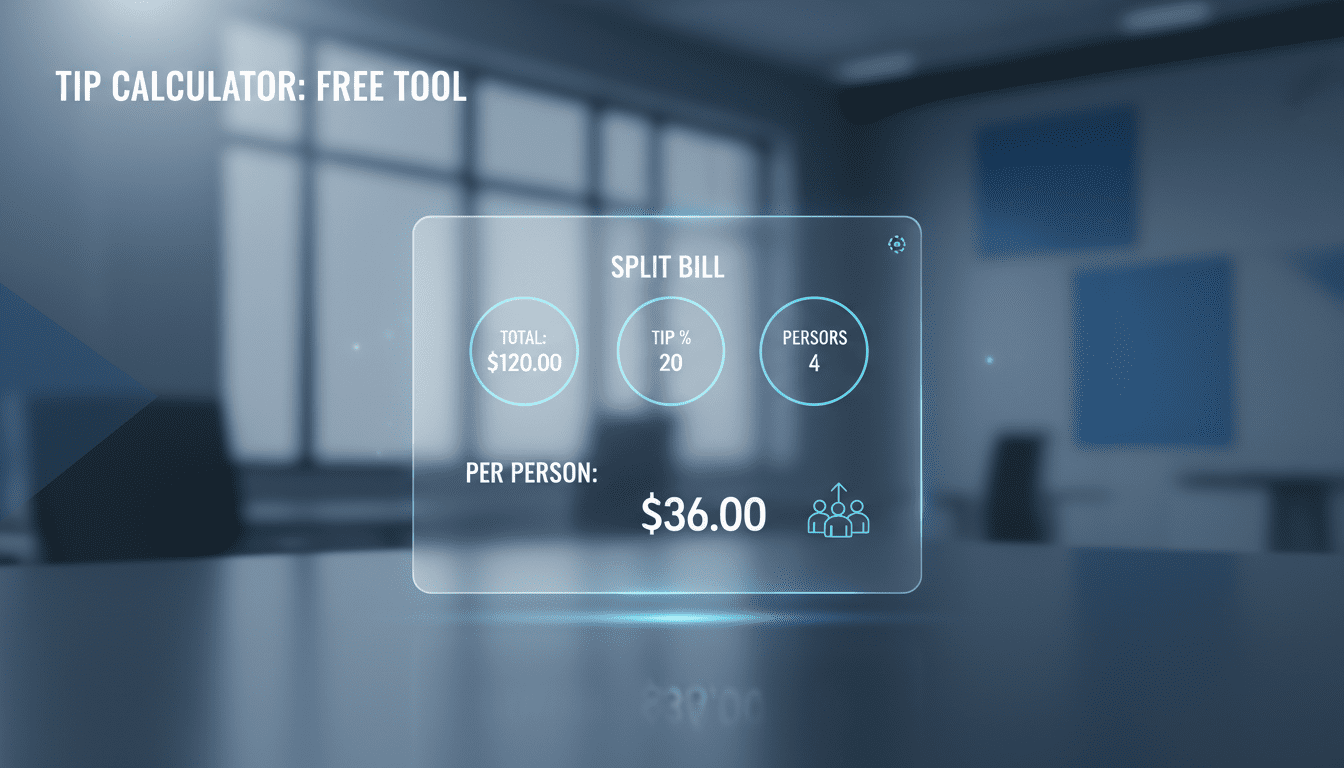
In the high-stakes environment of corporate dining and group financial management, the moment the check arrives is a critical juncture. It is a test of organizational competence and social grace. Fumbling with mental arithmetic or debating the fairness of a split can instantly erode the professional rapport built during the meal. Whether you are a founder treating potential investors, a manager organizing a team retrospective, or simply a group of colleagues navigating a shared expense, precision is paramount.
The modern professional requires tools that eliminate ambiguity. A robust Tip Calculator: Split Bill Per Person tool does more than perform basic division; it ensures equitable distribution of financial obligation, adheres to regional tipping etiquette, and streamlines the reimbursement process for expense reporting. This guide provides not only a bulletproof calculation engine but also a comprehensive analysis of tipping mechanics, global standards, and best practices for expense management.
Bill Split & Tip Calculator
The Mathematics of Equitable Dining
At its core, the division of a dining bill is a mathematical function involving percentages, addition, and division. While this may seem rudimentary, the variables introduced by service charges, tax rates, and social expectations complicate the equation. To maintain financial hygiene, one must understand the underlying components of the calculation.
The standard formula used in our calculator follows a logical order of operations:
- Base Calculation: Determine the gratuity based on the pre-tax or post-tax subtotal.
- Aggregation: Sum the bill amount and the calculated gratuity.
- Division: Divide the aggregate sum by the integer of participants.
While a standard percentage calculator can assist with the initial step of determining the tip amount, it lacks the workflow specific to dining scenarios, such as splitting the final result. This specific tool integrates those steps to prevent the "rounding errors" that often occur when a group attempts to do mental math after a few glasses of wine.
Pre-Tax vs. Post-Tax: The Eternal Debate
One of the most common points of confusion in bill splitting is whether to calculate the tip based on the subtotal (before tax) or the grand total (after tax). From a strict etiquette perspective, tipping is intended to reward the service provided by the staff. Taxes are a government mandate, not a service rendered by the restaurant.
Therefore, the "technically correct" method is to calculate the percentage based on the pre-tax amount. However, modern convenience often dictates otherwise. Most Point of Sale (POS) systems suggest tip amounts based on the final total, including tax. If you are in a jurisdiction with high sales tax, such as when using a tax calculator for Los Angeles, tipping on the post-tax amount can significantly increase the total gratuity. While generous, it is not strictly required by protocol.
Global Tipping Standards and Regional Nuances
Business travel necessitates a keen awareness of local customs. The "15-20% standard" is largely a North American construct. Applying this logic globally can lead to overspending or, conversely, accidental insults. Here is a breakdown of how tipping logic shifts across borders.
The European Model
In many European nations, service is included in the price of the meal or added as a distinct "service charge" on the bill. For example, if you are dining in the UK, you might want to consult a tax calculator for London to understand the VAT implications, but regarding tips, a discretionary 10-12.5% is often added automatically. If it is not, leaving 10% is considered polite, but the aggressive 20% standard of the US is not the norm.
The Middle East
The Middle East presents a hybrid model. In hubs like Dubai, high-end hospitality is the norm. While many establishments include a service charge, it is common practice to leave an additional amount for the waitstaff directly. Using a tax calculator for Dubai can help you understand the baseline costs, but be prepared to add 10-15% on top for exceptional service, similar to Western standards.
Asia and Oceania
In countries like Japan, tipping can be viewed as rude or confusing. In Australia and New Zealand, staff are paid a higher living wage, making tipping purely optional. However, as the gig economy grows, these norms are slowly shifting. Understanding the base wage of service workers via an hourly tax calculator can give you insight into why tipping cultures differ so drastically; where base wages are low, tips are a lifeline; where wages are high, tips are a bonus.
Expense Management and Corporate Policy
For the executive, the tip calculator is also a compliance tool. Corporate expense policies often have strict caps on gratuities—typically 20%. Submitting an expense report with a 25% tip because of a calculation error can trigger an audit or a rejection from the finance department.
When splitting a bill among colleagues who are all expensing their meals individually, exactness is crucial. If the total bill is $200 and four people split it, each receipt must reflect exactly $50. If one person pays $60 and another $40 due to lazy math, it complicates the reconciliation process. Utilizing a finance calculator approach to your dining expenses ensures that your monthly budget and expense reports remain accurate to the penny.
The "One Card" Strategy
The most efficient method for business dining is for the most senior person to pay the entire bill on a corporate card. This consolidates the expense into a single transaction. However, if personal cards are used, or if the meal is a mix of personal and business expenses, the "Split Bill" function of our tool becomes essential to determine who owes what to the payer.
Advanced Splitting Scenarios
Life rarely fits neatly into an even split. There are scenarios where a simple "divide by X" logic fails. In these instances, you must apply a weighted average approach.
The "Alcohol" Factor
A common friction point arises when half the table orders expensive wine while the other half drinks water. In this scenario, an even split is unfair to the non-drinkers. While our tool calculates an even split, you can use it to calculate the "drinkers' subtotal" and the "non-drinkers' subtotal" separately. This is a form of average calculator data analysis applied to dining—segmenting the data (costs) to find a fair mean for each subgroup.
The "Big Spender" Anomaly
Occasionally, a senior executive may wish to subsidize the meal without covering it entirely—perhaps paying for the appetizers and drinks while the team splits the entrees. This requires subtracting the subsidized amount from the total before applying the tip and split logic. It is a partial subsidy model often seen in startup cultures.
The Psychology of Tipping
Why do we tip? It is a social contract that serves as a feedback loop for service quality. However, it is also a display of status. In a business setting, under-tipping signals financial distress or a lack of generosity, neither of which are desirable traits in a partner. Over-tipping can signal recklessness.
Finding the "Goldilocks" zone—typically 18-20% in the US—signals competence. It shows you understand the market rate for service. Just as a salary calculator helps you benchmark your income against industry standards, a tip calculator helps you benchmark your gratuity against social standards.
Digital Tools vs. Mental Math
There is a lingering belief among some traditionalists that using a calculator at the table is gauche. This is an outdated view. In the era of smartphones, using a digital tool is a sign of diligence. It is far more professional to take ten seconds to ensure the server receives the correct amount and the bill is split accurately than to guess and make a mistake.
Furthermore, digital tools provide a record. By inputting the exact amounts, you are mentally verifying the bill. Restaurant errors happen—double charges, wrong items, or miscalculated taxes. The act of using a calculator forces you to look at the bill closely, acting as a final audit before payment.
FAQs: Expert Answers to Common Tipping Questions
Should I tip on the full amount if I have a discount coupon?
Yes. The standard etiquette is to tip on the original price of the meal, not the discounted price. The server's effort remains the same regardless of the coupon. If you have a $100 meal discounted to $50, you should calculate the tip based on the $100 value.
How do I handle splitting the bill with a large group?
For groups larger than six, many restaurants add an automatic gratuity (auto-grat). Check the bill first. If an auto-grat is included, you do not need to add more unless the service was extraordinary. Use the calculator to divide the final total by the number of people.
Is it rude to ask for separate checks?
In the US, it is generally acceptable if requested before ordering. In Europe, it is less common and can be seen as an annoyance to the waitstaff. It is often smoother for one person to pay and others to reimburse them using peer-to-peer payment apps, using the calculator to determine the exact amounts.
What if the service was terrible?
Tipping is discretionary. However, in the US system, servers rely on tips for their livelihood. If service was poor, a 10-12% tip sends a message without being punitive. Leaving $0 is generally considered hostile unless the experience was egregious.
Does the tip percentage change for delivery vs. dine-in?
Yes. For delivery, 10-15% is standard. For dine-in service, 15-20% is the expectation. The dine-in experience involves significantly more labor from the staff (refills, table maintenance, cleanup) compared to a drop-off delivery.
Conclusion
The "Tip Calculator: Split Bill Per Person" is more than a convenience; it is a tool for financial clarity and social smoothness. In a professional context, the way you handle money speaks volumes about your leadership style. By ensuring accuracy, fairness, and adherence to local customs, you transform a mundane transaction into a demonstration of competence.
Whether you are calculating a complex split in New York or navigating the service charges of London, having a reliable digital architect for your expenses ensures that the focus remains on the conversation and the relationship, not the receipt. Bookmark this page to ensure you are always prepared when the check arrives.
