
Blog
Salary Calculator: Hourly To Annual Pay Converter
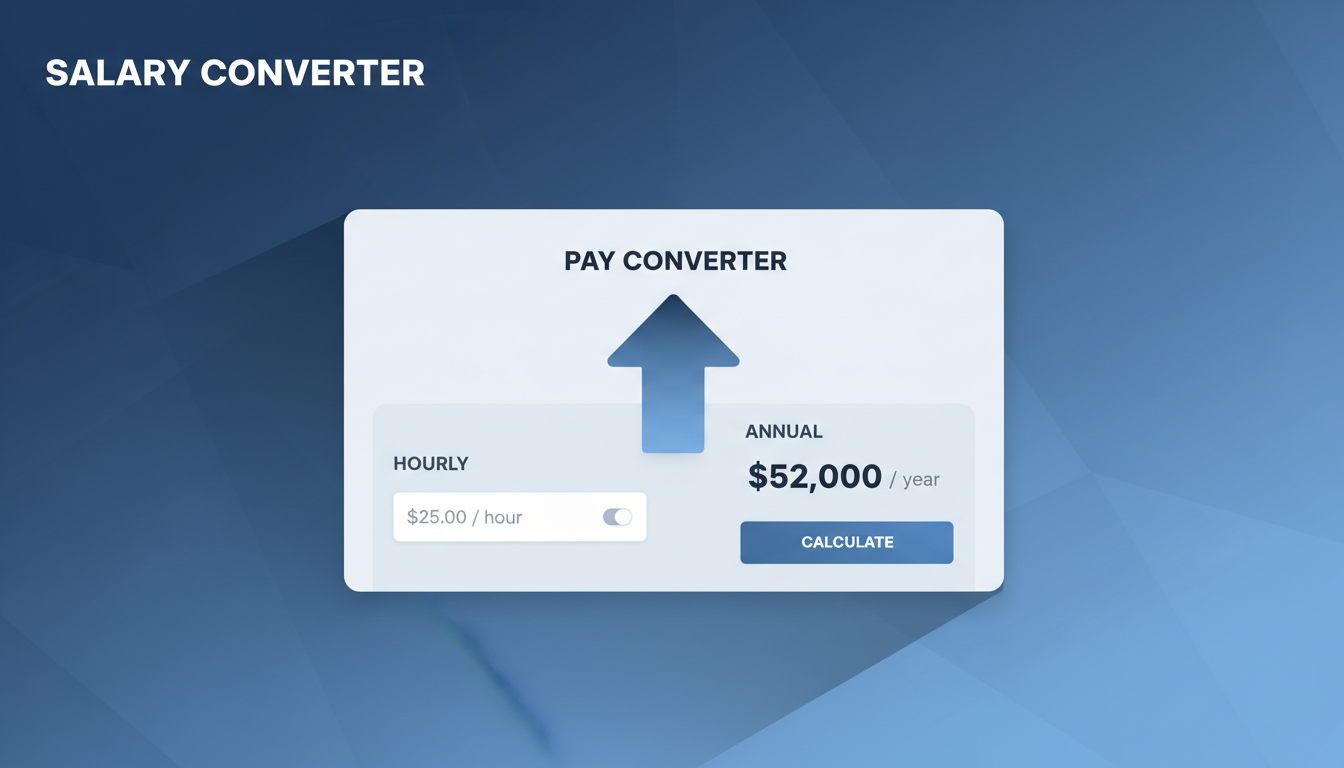
Hourly to Annual Pay Converter
In the high-stakes environment of executive management and talent acquisition, compensation clarity is not merely a preference—it is a strategic imperative. Whether you are a founder structuring an offer for a critical contractor, a hiring manager analyzing budget impact, or a professional negotiating a transition from freelance to full-time, the ability to fluidly translate between hourly rates and annual salaries is essential. The "2080-hour rule" is a standard heuristic, but precision is required when financial forecasting is on the line.
The interactive tool above provides an instant, accurate conversion based on your specific inputs. However, the raw numbers are only the beginning of the conversation. To truly leverage this data, one must understand the nuances of the work year, the impact of taxation across different jurisdictions, and the hidden variables that define "take-home" reality versus gross expenditure.
The Strategic Architecture of Compensation
When evaluating compensation, the distinction between an hourly wage and an annual salary extends beyond simple multiplication. It represents two fundamentally different relationships between an employer and a worker. Hourly arrangements often imply a direct correlation between time input and financial output, offering flexibility but lacking the stability of a salaried commitment. Conversely, annual salaries often bundle uncompensated overtime with benefits packages, creating a different value proposition.
For financial planning, understanding the conversion formula is critical. The standard calculation assumes a 40-hour work week multiplied by 52 weeks, resulting in 2,080 billable hours per year. However, this baseline rarely reflects reality. Paid time off (PTO), federal holidays, and sick leave reduce the actual productive hours, effectively increasing the "real" hourly cost of a salaried employee to the company.
The Mathematics of the Work Year
While 52 weeks is the standard multiplier, a calendar year is actually 52 weeks plus one day (or two in a leap year). This creates a statistical variance that payroll departments must account for. When using a tax calculator formula for precise budgeting, these small discrepancies can compound across a large workforce.
- Standard Year: 2,080 hours (40 hours x 52 weeks).
- Leap Year: 2,088 potential work hours.
- Effective Work Year: Often closer to 1,920 hours after accounting for 2 weeks of vacation and 10 federal holidays.
Gross Pay vs. Net Reality: The Tax Wedge
The calculator above provides Gross Pay—the total cost to the employer or the total earnings before the government takes its share. For executives and employees alike, the most critical figure is Net Pay. The disparity between these two figures is driven by the "tax wedge," which varies dramatically depending on geography.
A $100,000 salary in a state with no income tax offers significantly higher purchasing power than the same salary in a high-tax jurisdiction. If you are hiring or working in the tech hubs of the West Coast, utilizing a tax calculator california is essential to understand the true value of an offer. The state's progressive tax structure can significantly erode the nominal value of a high hourly rate.
Conversely, on the East Coast, the financial landscape shifts again. A professional considering a role in Manhattan must account for city, state, and federal levies. Running the numbers through a tax calculator new york will reveal that a higher gross salary is often required to maintain a standard of living comparable to other regions.
International Considerations
In today's remote-first economy, talent is borderless. However, tax laws are not. If you are employing contractors or staff in Europe, the conversion from hourly to annual pay must account for entirely different social security schemes. A tax calculator uk analysis, for example, will highlight the impact of National Insurance contributions, which differ fundamentally from US payroll taxes.
Advanced Compensation Models
For founders and C-suite executives, "salary" is often just one component of a broader compensation package. The hourly-to-annual conversion is a baseline, but wealth accumulation frequently relies on equity, bonuses, and dividends.
Many business owners opt for a lower base salary supplemented by dividends to optimize their tax position. This strategy requires careful modeling. Using a salary dividend tax calculator allows you to visualize the blended tax rate of taking, for example, a $50,000 salary versus a $100,000 dividend distribution. This "split" approach can drastically alter the effective hourly rate of the business owner.
The Contractor vs. Employee Calculation
When a company debates whether to hire a full-time employee (FTE) or a contractor, the hourly rate is deceptive. A contractor charging $100/hour might seem more expensive than an employee earning $80/hour ($166,400/year). However, the "fully loaded" cost of the employee includes:
- Employer-side FICA taxes (Social Security and Medicare).
- Health insurance contributions.
- 401(k) matching.
- Equipment and overhead.
When these factors are weighed, the contractor's premium often evaporates. Executives must look beyond the raw hourly rate and assess the Total Cost of Workforce (TCOW).
Lifestyle and Long-Term Planning
For the individual, converting an hourly wage to an annual salary is the first step in long-term financial planning. Banks and lenders rarely look at hourly rates; they look at annualized income stability. Whether the goal is securing a loan or planning for retirement, the annual figure is the currency of credit.
A common scenario involves a freelancer moving to a salaried role to qualify for a home loan. Once the annual salary is determined, the next logical step is to input that figure into a mortgage calculator to determine borrowing power. The stability of a salary often unlocks lower interest rates and higher loan-to-value ratios than variable hourly income.
Optimizing for Location and Cost of Living
The value of a dollar is relative to its location. We have discussed California and New York, but what about other jurisdictions? The rise of the "Silicon Prairie" and other tech hubs has led to a migration of talent to states with more favorable tax treatments.
For example, an offer in Austin or Dallas benefits from the lack of state income tax. However, property taxes may be higher. A comprehensive analysis might involve comparing a role in San Francisco against one in London or Berlin. While a tax calculator formula helps with the math, understanding the local statutory requirements is key.
If you are looking at the DACH region, a tax calculator germany is indispensable due to the complexity of the solidarity surcharge and church tax. Similarly, understanding the "superannuation" in Australia via a tax calculator australia is vital for any US-based company hiring Down Under.
Budgeting for Growth
For the hiring manager, the Salary Calculator is a budgeting tool. When a department is allocated a $1M budget for new hires, accurate conversion allows for precise headcount planning. It helps answer questions such as:
- Can we afford three senior engineers at $85/hour, or should we hire four mid-level engineers at $110,000/year?
- What is the burn rate impact if we increase the work week to 45 hours for key sprints?
- How does a 4-day work week (32 hours) impact the annualized compensation strategy?
Furthermore, for general financial literacy and quick estimations during meetings, keeping a link to our blog and tools ensures you have access to the necessary data to make informed decisions on the fly.
Frequently Asked Questions (FAQ)
How do I calculate annual salary from an hourly rate?
To calculate the annual salary, multiply the hourly wage by the number of hours worked per week, and then multiply that figure by the number of weeks worked in a year. The standard formula for a full-time employee is: Hourly Rate × 40 hours × 52 weeks.
Does this calculator account for taxes and deductions?
No, this calculator determines Gross Pay only. It does not account for federal or state taxes, insurance premiums, or retirement contributions. To estimate your take-home pay, you should use a location-specific tool, such as a tax calculator new york or a tax calculator uk, depending on your residence.
What is the difference between billable hours and payable hours?
Payable hours are the total hours an employee is paid for, often including vacation and sick time (typically 2,080 hours/year). Billable hours are the hours an employee works on revenue-generating tasks for clients. For professional services firms, the ratio between these two (utilization rate) is a key performance metric.
How does a leap year affect hourly to salary conversion?
In a leap year, there is one extra day, bringing the total days to 366. For hourly employees, this may result in an extra 8 hours of pay if the extra day falls on a workday. For salaried employees, the annual pay usually remains the same, meaning the effective hourly rate drops slightly for that year.
Why is the "2080 hours" rule used?
The 2080-hour rule is a simplification used for accounting and payroll. It assumes a 40-hour work week multiplied by 52 weeks. While convenient, it does not account for the fact that a year is actually 52 weeks plus 1 day, nor does it account for unpaid leave. It serves as a baseline for converting annual salaries into hourly rates for overtime calculations.
Conclusion
Mastering the conversion between hourly wages and annual salaries is a fundamental skill for modern financial stewardship. Whether you are an executive optimizing a P&L statement, a founder navigating the complexities of international hiring, or an individual planning a financial future, the numbers tell a story. By utilizing the Hourly to Annual Pay Converter and understanding the broader context of taxation and benefits, you can move beyond simple arithmetic and into the realm of strategic financial planning.
