
Blog
Inflation Adjusted Salary Calculator 2026: Real Worth
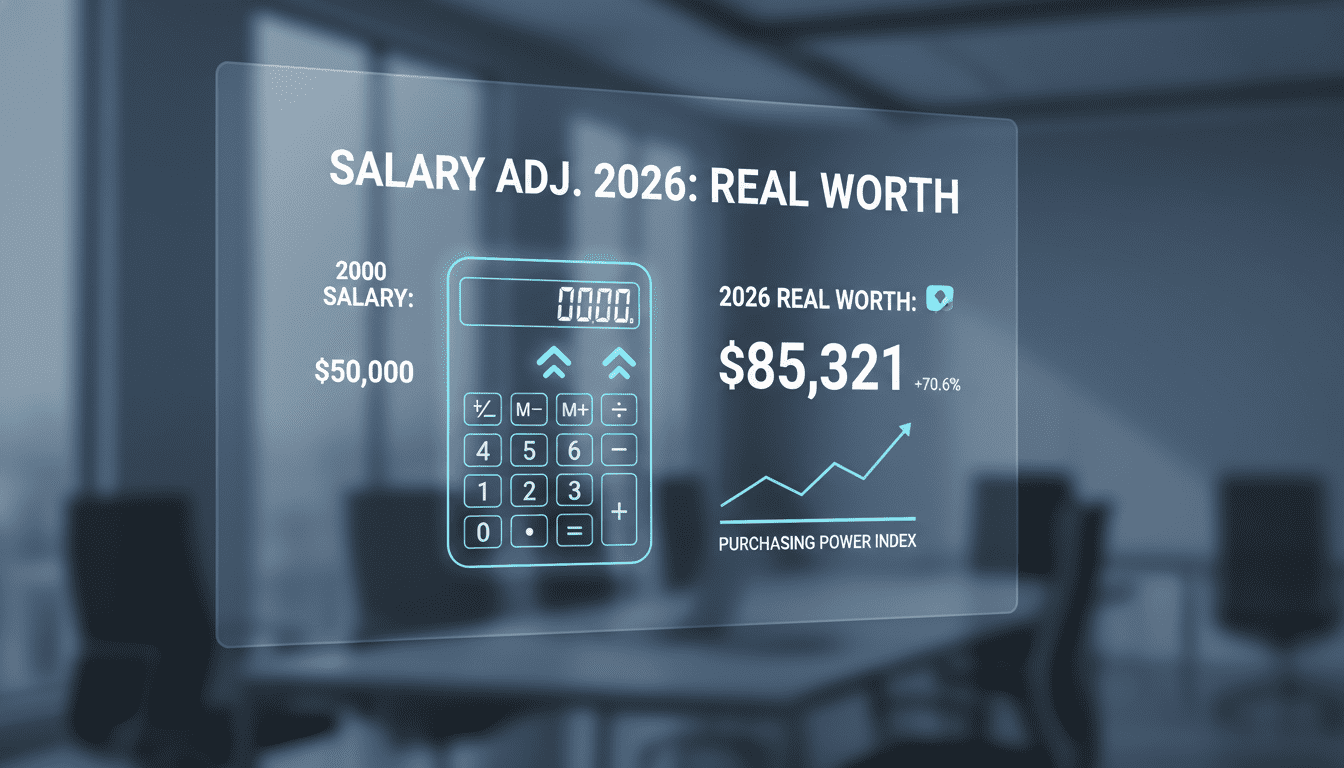
In the fiscal landscape of 2026, the number printed on a paycheck tells only a fraction of the story. For founders, executives, and hiring managers, the distinction between nominal income and real purchasing power has become the defining metric of financial health. As global economies stabilize following years of volatility, the Inflation Adjusted Salary Calculator 2026 is not merely a tool for curiosity—it is a critical instrument for wealth preservation and strategic compensation planning.
Inflation acts as a silent tax, eroding the value of currency over time. A salary of $100,000 in 2021 does not command the same market authority in 2026. Without precise adjustment, what appears to be a stable income is, in mathematical reality, a progressive pay cut. This guide provides an authoritative analysis of real wage calculation, the mechanics of the Consumer Price Index (CPI), and actionable strategies to ensure your compensation keeps pace with the economic reality of 2026.
Inflation Adjusted Salary Calculator 2026
$0.00
$0.00
$0.00
Calculations are based on the input inflation rate. Use official CPI data for precise historical adjustments.
The Mechanics of Real Worth: Beyond the Nominal Number
To navigate the 2026 economy effectively, one must understand the fundamental difference between nominal wages and real wages. Nominal wages refer to the absolute amount of money paid to an employee, unadjusted for inflation. Real wages, conversely, represent the purchasing power of that money—literally, the quantity of goods and services that can be bought.
The erosion of purchasing power is driven by the Consumer Price Index (CPI), a measure that examines the weighted average of prices of a basket of consumer goods and services, such as transportation, food, and medical care. When the CPI rises, the value of the dollar falls. For professionals negotiating salaries or founders setting budgets, relying on nominal figures without applying a robust tax calculator formula and inflation adjustment leads to flawed financial projections.
The Compounding Effect of Inflation (2020-2026)
The period from 2020 to 2026 has witnessed significant economic shifts. The cumulative inflation during this window means that a dollar saved or earned at the beginning of the decade has significantly less utility today. This is not linear; it is compounding. If inflation averages 3% to 5% annually, the aggregate loss of purchasing power over six years is substantial.
For example, an executive who has not received a raise since 2022 is effectively earning 15% to 20% less in 2026 terms, depending on the specific CPI data. This "invisible" reduction in pay often goes unnoticed until major purchases—such as real estate or tuition—reveal the disparity between income and market costs.
Strategic Compensation Planning for 2026
For hiring managers and business owners, the "Inflation Adjusted Salary Calculator 2026" is a retention tool. In a competitive talent market, offering a nominal raise that fails to beat inflation is a recipe for turnover. Employees are increasingly financially literate; they understand that a 3% raise in a 4% inflation environment is a 1% pay cut.
Geographic Disparities in Purchasing Power
Inflation does not impact every region equally. While national CPI provides a baseline, local economies fluctuate based on housing supply, state tax legislation, and regional supply chains. A salary that provides a comfortable lifestyle in the Midwest may be near the poverty line in coastal tech hubs.
When calculating real worth, you must factor in the local tax burden. For instance, a high earner in the Golden State faces a significantly different net outcome than one in a tax-free state. Utilizing a specific tax calculator for California allows for a granular analysis of how state levies compound with inflation to reduce disposable income. Conversely, comparing this to a tax calculator for Chicago reveals how property taxes and local municipal fees in Illinois might offset the benefits of a lower cost of living compared to the West Coast.
The "Bracket Creep" Phenomenon
One of the most insidious effects of inflation on salary is "bracket creep." This occurs when an inflation-adjusted raise pushes an earner into a higher tax bracket. While the employee's purchasing power has theoretically stayed the same (gross pay matched inflation), their net pay may actually decrease in real terms because a larger percentage of their income is now taxed at a higher marginal rate.
To combat this, sophisticated financial planning is required. It is not enough to simply match the CPI percentage. Compensation packages must be modeled using a comprehensive finance calculator to ensure that the net real wage remains positive after federal and state liabilities are settled.
For Founders and the Self-Employed
The stakes are even higher for entrepreneurs and freelancers. Unlike salaried employees who may receive automatic Cost of Living Adjustments (COLAs), the self-employed must actively raise their rates to survive. If you are a consultant or contractor, your hourly rate from 2024 is likely insufficient in 2026.
Using an hours calculator to determine your billable capacity, and then cross-referencing that with inflation data, is essential for setting 2026 pricing. Furthermore, business expenses—software subscriptions, equipment, and travel—have likely risen faster than the general CPI. Founders should utilize a business tax calculator to forecast how these increased operational costs, combined with inflation, affect the company's bottom line and the founder's personal draw.
Engineering a Resilient Compensation Package
In 2026, cash is only one component of "Real Worth." To insulate against inflation, many organizations are turning to equity, performance bonuses, and enhanced benefits. For technical roles, where base salaries are already high, the differentiation often comes from stock options.
However, valuing equity requires complex math. An online scientific calculator for engineering or financial modeling is often necessary to project the future value of vested shares against potential inflation scenarios. If the company's valuation grows slower than the rate of inflation, the "golden handcuffs" of equity may turn out to be golden plated lead.
Actionable Steps for Employees
- Audit Your Income: Use the calculator above to determine the 2026 equivalent of your starting salary. If your current pay is lower than the result, you are earning less than when you started.
- Leverage Data in Reviews: Do not ask for a raise based on "hard work" alone. Present the data: "To simply maintain the purchasing power I had in 2023, my salary needs to be adjusted by X%."
- Consider Total Compensation: If a cash raise isn't possible, negotiate for non-monetary benefits that offset costs, such as remote work stipends or covered health premiums.
Actionable Steps for Employers
- Proactive Adjustments: Don't wait for exit interviews. Conduct an annual salary audit against the current CPI.
- Transparent Communication: If you cannot match inflation, be transparent about why, and offer other avenues for value creation, such as profit-sharing.
- Regional Pay Bands: Move away from a single national pay scale. Adjust bands based on the real cost of living in the employee's specific location.
The Role of Lifestyle Inflation
While economic inflation is external, "lifestyle inflation" is internal. This occurs when an individual's spending increases as their income rises. In 2026, avoiding lifestyle inflation is the most effective hedge against economic inflation. By maintaining a 2023 standard of living on a 2026 salary, you create a surplus that can be invested in assets that historically outpace inflation, such as equities or real estate.
For more insights on managing personal wealth and understanding the nuances of economic shifts, explore our blog, which covers everything from tax strategies to investment calculus.
Frequently Asked Questions
What is the difference between CPI and PCE regarding salary adjustments?
The Consumer Price Index (CPI) measures out-of-pocket expenditures for urban consumers and is the standard for adjusting salaries. The Personal Consumption Expenditures (PCE) index is broader and often used by the Federal Reserve for monetary policy. For salary negotiations, CPI is generally the preferred metric as it more closely reflects the cost of living changes felt by employees.
How often should I adjust my salary expectations for inflation?
Ideally, you should review your salary against inflation data annually. However, in periods of high volatility (inflation rates above 4%), a semi-annual review may be necessary to ensure your purchasing power isn't eroding too quickly. Use the calculator above every six months to track your real worth.
Does this calculator account for taxes?
The calculator above determines gross salary adjustments needed to match inflation. It does not automatically calculate the tax implications of that higher salary. As mentioned, earning more can push you into a higher tax bracket. We recommend using a dedicated tax tool alongside this calculator for a net-income view.
Why does my personal inflation rate feel higher than the official CPI?
The official CPI is an average based on a "basket" of goods. If your personal spending is heavily weighted toward categories that have seen extreme price hikes—such as housing, education, or healthcare—your personal inflation rate will be higher than the national average. You should adjust your salary requirements based on your personal expense tracking rather than just the national number.
Is equity a good hedge against inflation?
Generally, yes. Stocks and business equity tend to appreciate over the long term, often outpacing inflation. However, they carry risk. A fixed salary loses value with certainty due to inflation; equity may gain value but can also lose it. A balanced compensation package usually includes both.
Conclusion
The Inflation Adjusted Salary Calculator 2026 is more than a mathematical novelty; it is a lens through which we must view our financial reality. In an era where the value of money is in constant flux, resting on the laurels of a static salary is a strategy for regression. By understanding the mechanics of inflation, leveraging precise calculation tools, and accounting for tax and geographic variables, you can ensure that your hard work translates into real, enduring wealth.
Whether you are an executive strategizing for the fiscal year ahead or a professional advocating for your fair share, remember: it is not about how much you make, but how much that money can buy. Use the data, plan strategically, and secure your financial future in 2026 and beyond.
