
Blog
Tire Size Calculator: Compare Specs & Speed Error
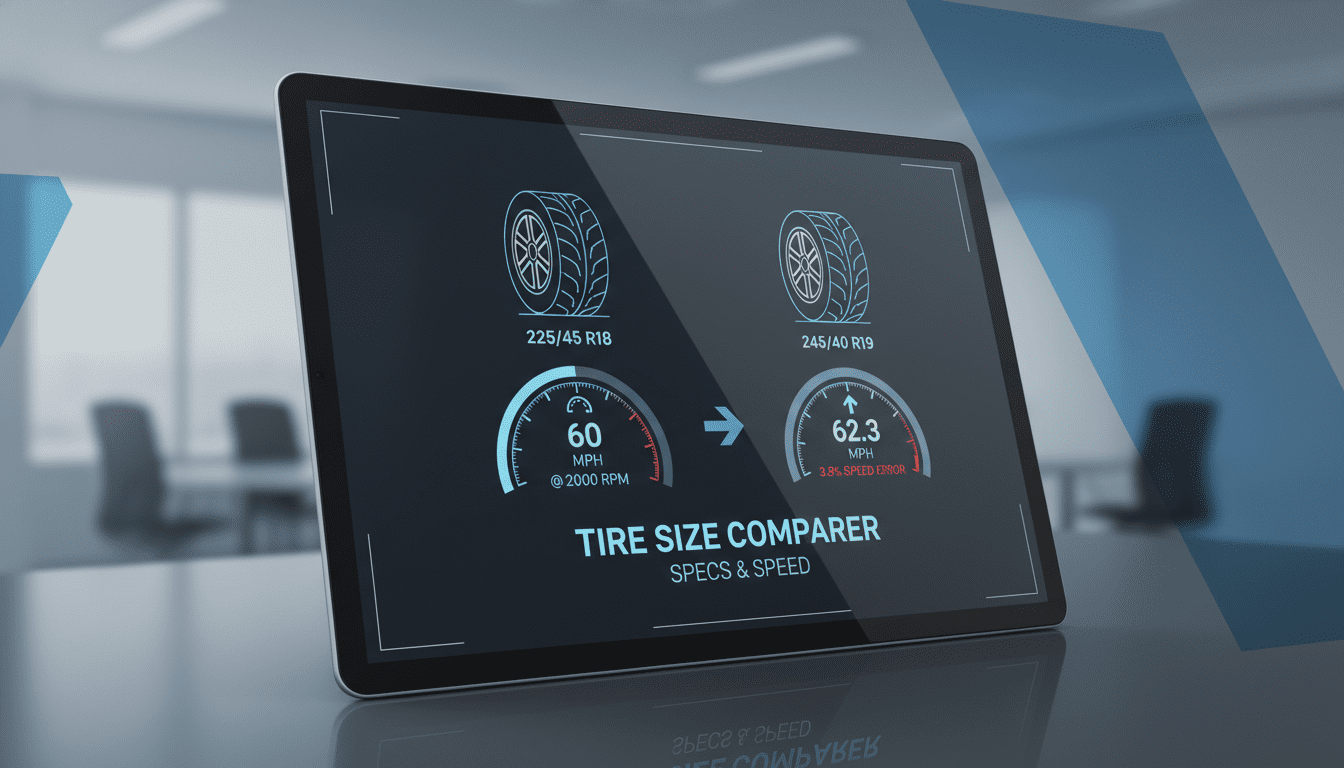
Precision is the currency of modern fleet management and automotive engineering. When modifying vehicle specifications, particularly the interface between the chassis and the road, “close enough” is a recipe for mechanical inefficiency, safety hazards, and regulatory non-compliance. Whether you are a logistics director optimizing fuel consumption across a fleet of heavy-duty trucks or an enthusiast fine-tuning the suspension geometry of a high-performance vehicle, understanding the mathematical implications of tire size changes is non-negotiable.
Changing a vehicle’s tire size impacts far more than aesthetic stance. It alters the effective final drive ratio, shifts the torque curve relative to road speed, confuses the transmission control module (TCM), and introduces variance into the speedometer and odometer readings. In modern vehicles equipped with sensitive Anti-lock Braking Systems (ABS) and Electronic Stability Programs (ESP), a diameter variance exceeding 3% can trigger fault codes or, worse, engage safety systems unpredictably during cornering.
The following Tire Size Calculator is engineered to provide instant, accurate data regarding diameter variance, circumference changes, and speedometer error. Following the tool, we provide a comprehensive technical analysis of tire dynamics to support your decision-making process.
Professional Tire Specification Analyzer
Current Specification (Tire 1)
New Specification (Tire 2)
Analysis Results
| Metric | Current | New | Difference |
|---|---|---|---|
| Diameter | |||
| Circumference | |||
| Revs Per Mile | |||
| Speedometer @ 60mph | 60 mph |
*Note: A positive difference indicates the new tire is larger. Speedometer readings assume the vehicle is calibrated to Tire 1.
The Engineering Behind Tire Specifications
To the untrained eye, a tire is simply a rubber donut. To an engineer, it is a complex composite of steel, polyester, and rubber compounds designed to handle specific load vectors and rotational forces. The alphanumeric code molded into the sidewall—the ISO Metric Tire Code—is a precise formula that dictates the tire’s physical dimensions and capabilities.
Understanding these metrics is crucial. For instance, when calculating the precise load distribution for a commercial vehicle, one might use an online scientific calculator to determine the exact center of gravity shifts. Similarly, tire specs must be calculated with high precision.
Decoding the ISO Metric Code
- Section Width (e.g., 205): This is the width of the tire in millimeters, measured from the widest point of the inner sidewall to the widest point of the outer sidewall. It is not the width of the tread that touches the road.
- Aspect Ratio (e.g., 55): This is a percentage, not a direct measurement. It represents the height of the sidewall relative to the width. A “55” means the sidewall height is 55% of the section width. Lower numbers indicate a “low profile” tire, typically used for performance to reduce sidewall flex during cornering.
- Construction (e.g., R): “R” stands for Radial construction, the industry standard for passenger vehicles.
- Rim Diameter (e.g., 16): The diameter of the wheel (in inches) that the tire is designed to fit.
The Physics of Rolling Diameter and Drivetrain Impact
The most critical output of our calculator is the Overall Diameter. This figure is the master variable that affects your vehicle’s gearing. Your vehicle’s transmission and differential are engineered with specific gear ratios designed to work with a specific tire diameter. This relationship determines the engine RPM at a given highway speed.
Torque and Acceleration
Installing a tire with a larger diameter is mechanically similar to shifting into a higher gear. It increases the circumference, meaning the tire covers more ground per revolution. While this might theoretically increase top speed, it reduces the effective torque available at the wheels. The engine must work harder to turn the larger, heavier tire.
For fleet managers, this is a capital expenditure issue. If you upgrade a fleet of delivery vans to larger, more aggressive tires for aesthetics or mild off-road capability, you may inadvertently increase strain on the transmission and reduce the vehicle’s towing capacity. Before committing to such an upgrade, it is wise to use a loan calculator to model the potential costs of increased maintenance and premature drivetrain failure against the perceived benefits of the upgrade.
Unsprung Weight and Rotational Mass
Larger tires almost always carry more mass. This is “unsprung weight”—weight not supported by the vehicle’s suspension. Physics dictates that rotational mass has roughly three times the impact on acceleration and braking performance compared to static weight. A heavier tire requires more energy to spin up (acceleration) and more thermal energy to slow down (braking). This leads to increased brake pad wear and reduced fuel efficiency.
Speedometer Error and Legal Compliance
Vehicle speedometers are not GPS devices; they are revolution counters. They measure the rotational speed of the transmission output shaft or the axles and convert that data into miles per hour based on the factory tire diameter.
When you change the tire diameter, you break this calibration.
- Larger Tires: The speedometer reads slower than you are actually traveling. If your speedometer says 65 mph, you might be doing 70 mph. This puts drivers at risk of unintentional speeding tickets.
- Smaller Tires: The speedometer reads faster than actual speed. This causes the odometer to rack up miles faster than reality, depreciating the vehicle’s value prematurely.
For logistics companies, accurate time and distance tracking is the backbone of profitability. Just as a project manager relies on a time duration calculator to optimize supply chain schedules, a fleet manager must ensure that vehicle odometers are accurate to maintain valid maintenance logs and resale values.
Safety Systems: ABS and Traction Control
Modern vehicles are governed by ECUs (Electronic Control Units) that rely on wheel speed sensors. These sensors monitor the rotation of each wheel hundreds of times per second. The ABS system expects all wheels to rotate at a specific rate relative to the vehicle’s speed.
If you install tires with a significant diameter variance (generally over 3%), the ECU may interpret the difference in rotational speed as wheel slip. This can cause:
- Phantom ABS Activation: The brakes may pulse unexpectedly on dry pavement.
- Traction Control Intervention: The engine may cut power during acceleration because the computer believes the vehicle is losing traction.
- Transmission Limp Mode: In severe cases, the transmission may refuse to shift gears to protect itself.
This is particularly relevant in regions with strict vehicle inspection standards. Regulatory bodies, similar to the rigid frameworks found when using a Kerala MVD tax calculator for vehicle compliance, often have specific tolerances for tire modifications. Exceeding these can render a vehicle unroadworthy in the eyes of the law and insurance providers.
Fuel Economy and Operational Costs
The relationship between tire size and fuel economy is non-linear. While a taller tire can lower engine RPM at highway speeds (potentially saving fuel), the increased aerodynamic drag (due to a wider profile) and increased rolling resistance (due to a larger contact patch) often negate these benefits.
In the construction industry, where heavy machinery and transport trucks operate on thin margins, accurate estimation is vital. Just as a site manager uses a concrete calculator for construction estimates to prevent material waste, a fleet operator must calculate the “burn rate” of fuel caused by non-standard tires. A 2 mpg loss across a fleet of 50 vehicles traveling 50,000 miles annually represents a massive financial leak.
Furthermore, budgeting for these operational variances is essential. Executives should utilize a salary calculator and budget planning tools to ensure that the increased operational costs of modified vehicles do not eat into personnel budgets or profitability.
Frequently Asked Questions
What is “Plus Sizing”?
Plus sizing is the practice of increasing the wheel diameter while decreasing the tire’s aspect ratio to maintain the same overall diameter. For example, “Plus 1” means increasing the rim by 1 inch and reducing the sidewall height proportionally. This improves handling response without affecting the speedometer or gear ratio.
Can I mix different tire sizes on my vehicle?
Generally, no. Mixing tire sizes (staggered fitment) is only safe if the vehicle was designed for it (common in high-end sports cars). On All-Wheel Drive (AWD) vehicles, all four tires must be within a very strict tolerance (usually within 2/32nds of an inch in tread depth) to prevent destroying the center differential.
How does tire width affect hydroplaning?
Wider tires have a larger contact patch, which is great for dry traction. However, they also act like a wider ski on water. Wider tires are more susceptible to hydroplaning because they have to displace more water per inch of forward travel. If you live in a rainy climate, sticking to the OEM width or slightly narrower is often safer.
What is the Load Index and why does it matter?
The Load Index is a number (e.g., 91, 100) that indicates the maximum weight a tire can support. When changing tire sizes, you must never select a tire with a lower Load Index than the factory recommendation. Doing so risks a blowout under load.
Will changing tire size void my warranty?
It is possible. If a dealership can prove that a drivetrain failure (such as a broken differential or transmission issue) was caused by the increased stress of significantly larger or heavier tires, they may deny a warranty claim.
Conclusion
Modifying your vehicle’s tire size is a decision that extends beyond the visual appeal of filling out the wheel well. It is a modification that alters the fundamental physics of how your vehicle accelerates, stops, and communicates with its own safety systems.
By utilizing the Tire Size Calculator above, you can quantify these changes before making a purchase. Keep the diameter variance under 3%, ensure your Load Index meets or exceeds OEM specifications, and be aware of the speedometer error. In the world of automotive engineering, data is the ultimate safety feature.
