
Blog
Groww Tax Calculator Alternative: India Income Tax Estimator
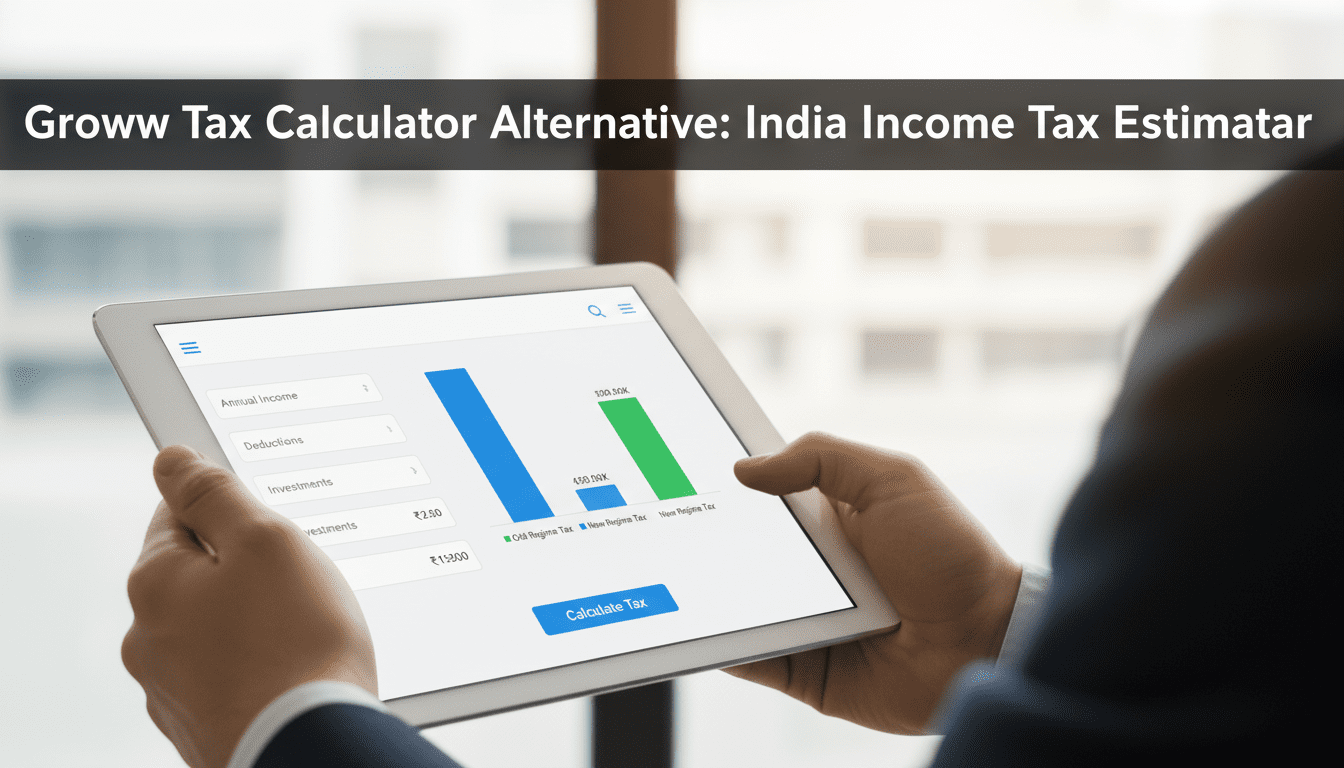
Precision Financial Forecasting for the Modern Executive
For founders, C-suite executives, and business leaders, accurate financial forecasting is as critical as revenue generation. While mass-market tools like the groww tax calculator alternative search results often provide excellent starting points for general users, high-net-worth individuals (HNIs) and corporate decision-makers often require a more granular approach to tax estimation. Navigating the nuances between the Old and New Tax Regimes requires more than a simple input-output mechanism; it demands a strategic understanding of deductions, surcharges, and long-term liability planning.
This comprehensive guide and advanced estimator provide a sophisticated alternative to standard market tools. Whether you are evaluating the impact of the latest Union Budget, restructuring your salary components for maximum efficiency, or comparing your liability against a tax calculator excel template, this tool is designed to offer clarity. Below, you will find a fully functional income tax calculator, followed by an in-depth strategic analysis of India’s taxation landscape.
Advanced India Income Tax Estimator (FY 2024-25)
Estimated Tax Breakdown
Understanding the Need for Precision Over Speed
When professionals search for a Groww tax calculator alternative, they are typically looking for more than just a quick estimate. They are looking for a tool that respects the complexity of their financial portfolio. As income levels rise, the complexity of tax planning increases disproportionately. For executives and founders, a generic calculator often overlooks critical nuances such as surcharge marginal relief, specific exemptions under Section 10, or the strategic interplay between salary structuring and investment planning. While mass-market calculators are efficient tools for the general public, discerning leaders require a deeper analysis.
This article serves as a companion to the estimator above, breaking down the mechanics of the Indian tax system. We will explore why the choice between the Old and New Regimes is no longer straightforward and how recent fiscal updates impact high earners. Furthermore, we will discuss how this logic compares to international standards, such as those found in a tax calculator new york or other high-tax jurisdictions.
The Strategic Shift: Old vs. New Tax Regime
The Government of India has been actively pushing the New Tax Regime, making it the default option. For the fiscal year 2024-25 (Assessment Year 2025-26), the slab structures were revised to make the New Regime more attractive. However, for individuals with significant commitments to home loans, insurance, and long-term savings, the Old Regime often remains superior.
1. The New Regime: Simplicity and Lower Rates
The New Regime is designed to be "exemption-less." It offers lower tax rates but strips away most popular deductions like 80C (PPF, ELSS, LIC) and 80D (Medical Insurance). However, it now includes a Standard Deduction (increased to ₹75,000 in recent updates), making it slightly more palpable for salaried employees. This shift mirrors the simplified tax structures seen in other nations, similar to the logic used in a tax calculator switzerland, where flat rates or simplified deductions are preferred over complex itemizations.
- Pros: Significantly lower tax rates; reduced compliance burden; no need to lock in funds for 3-15 years just to save tax.
- Cons: No benefit from HRA, LTA, or Home Loan interest deductions; limits the ability to lower tax liability through strategic investments.
2. The Old Regime: The Power of Deductions
The Old Regime retains the classic slab structure. While the rates are higher, the effective taxable income can be drastically reduced through intelligent planning. This requires a robust understanding of the tax calculator formula used to derive taxable income.
- Section 80C: Up to ₹1.5 Lakh reduction for investments in EPF, PPF, ELSS, etc.
- Section 80D: Deductions for health insurance premiums for self and parents (up to ₹1 Lakh in specific cases).
- Section 24(b): Up to ₹2 Lakh deduction on home loan interest. This is a critical component for anyone using a property purchase tax calculator to evaluate real estate investments.
- HRA: Significant relief for those living in rented accommodation.
For a founder drawing a salary of ₹30 Lakhs with a home loan and family insurance, the Old Regime often yields lower tax outflows compared to the New Regime, despite the higher headline rates.
Tax Planning for High-Net-Worth Individuals (HNIs)
When utilizing tools like the Groww tax calculator or the alternative provided above, HNIs must pay close attention to Surcharges. Surcharges are an additional tax levied on the tax payable, not the income itself, and they apply when income exceeds specific thresholds (₹50L, ₹1Cr, ₹2Cr, ₹5Cr).
Managing Surcharges and Marginal Relief
A common pitfall for executives is crossing a surcharge threshold by a small margin. For instance, if your income is ₹51 Lakhs, you become liable for a 10% surcharge on your total tax. In many cases, the additional tax exceeds the income earned above ₹50 Lakhs. This is where "Marginal Relief" comes into play. A sophisticated calculation ensures that the surcharge does not exceed the income over the threshold. This concept is not unique to India; similar progressive tax cliffs are observed when using a tax calculator japan or other tiered systems.
Furthermore, the surcharge rate in the New Regime has been capped at 25% for incomes exceeding ₹2 Crores, whereas under the Old Regime, it can go up to 37% for incomes above ₹5 Crores. This single factor often drives ultra-high-net-worth individuals toward the New Regime.
Optimizing Salary Structure
Founders and HR leaders should look beyond the basic inputs found in a standard search. Structuring a compensation package is a legal way to minimize tax liability. This requires more than a basic math calculator; it requires a strategic allocation of funds.
- National Pension System (NPS): Under Section 80CCD(2), an employer's contribution to an employee's NPS account (up to 10% of Basic + DA) is tax-exempt. This is over and above the ₹1.5 Lakh limit of 80C.
- Leave Travel Allowance (LTA): Can be claimed twice in a block of four years for domestic travel expenses.
- Vehicle Lease: Company-leased vehicles can offer significant tax advantages compared to owning a car personally, a factor often analyzed alongside a vehicle tax calculator.
- Food and Fuel Allowances: While smaller in quantum, these tax-free perquisites add up over a year.
Comparison: Custom Estimators vs. Market Standard Tools
Why choose a dedicated, detailed estimator over a quick online widget? Market tools are optimized for speed and user acquisition. They often default to standard assumptions that may not apply to complex financial portfolios. For example, many basic calculators fail to accurately split interest income types (Savings vs. FD) or account for specific senior citizen rebate nuances under Section 80TTB.
Reliable financial planning requires a tool that allows you to toggle between regimes instantly while seeing the impact of specific line items like HRA or Home Loan interest. The interface provided above focuses on these critical variables without the distraction of cross-selling financial products. This approach is similar to specialized tools like a tax calculator jackson hewitt alternative in the US, which focuses on detailed scenarios rather than generic estimates.
Advanced Scenarios: Business Income and Presumptive Taxation
For consultants, freelancers, and small business owners, the rules differ slightly. Sections 44AD and 44ADA allow for presumptive taxation, where you declare a percentage of your turnover as income. This simplifies compliance significantly. While our estimator focuses on salaried individuals, understanding presumptive schemes is vital for the gig economy workforce. This mirrors simplified tax schemes found globally, such as those calculated by a tax calculator ontario for small business owners in Canada.
If you are managing complex business revenues, you might need to employ an online scientific calculator to project compound growth of your retained earnings post-tax, ensuring your business liquidity remains healthy.
The Role of Technology in Tax Compliance
The Indian tax infrastructure (Income Tax Portal 2.0) has become increasingly digitized. Pre-filled forms are now the norm. However, pre-filled data is not always optimized data. Relying solely on the government's pre-filled numbers might mean missing out on deductions you are legally entitled to. Using an independent estimator acts as a "check and balance" system. It is similar to how one might use a tax calculator dawn alternative to verify figures provided by automated payroll software.
Frequently Asked Questions (FAQs)
1. Which tax regime is better for a salary above ₹15 Lakhs?
If you do not have significant deductions (Home Loan, HRA, 80C), the New Regime is generally better due to lower slab rates. However, if your total eligible deductions exceed ₹3.75 Lakhs (approx), the Old Regime may still save you more money. Always run the numbers on the estimator above.
2. Can I switch between Old and New Regimes every year?
Salaried individuals can choose their preferred regime every year at the time of filing returns. However, individuals with business or professional income are restricted; once they opt for the New Regime, they can only switch back to the Old Regime once in their lifetime.
3. Does the Groww tax calculator account for the latest budget changes?
Major platforms typically update their tools shortly after budget announcements. However, always verify if the calculator explicitly mentions the current Assessment Year (e.g., AY 2025-26) to ensure you are not using outdated slab logic. Our tool is updated for the FY 2024-25 parameters.
4. Is the Standard Deduction available in the New Regime?
Yes, as per recent budget updates, the Standard Deduction (₹75,000) is now available under the New Tax Regime, making it more attractive for salaried employees.
5. How is HRA calculated for tax exemption?
HRA exemption is the lowest of three: (a) Actual HRA received, (b) 50% of Basic Salary (metro) or 40% (non-metro), or (c) Rent paid minus 10% of Basic Salary. A calculator simplifies this complex comparison.
Conclusion
While searching for terms like "tax calculator groww" indicates a need for quick answers, true financial optimization requires a more deliberate approach. For founders and executives, tax is not just a statutory obligation but a significant expense line item that can be managed. By utilizing the advanced estimator provided here and understanding the strategic levers available under the Indian Income Tax Act, you can ensure that you are not just compliant, but legally tax-efficient.
Remember that tax laws are dynamic. Whether you are comparing your liability to international benchmarks using a fbr tax calculator or simply planning your domestic savings, the key is proactive management. Always consult with a Chartered Accountant for final filings, but use tools like this to drive informed conversations and decisions regarding your wealth.
