
Blog
Date Night Budget Calculator: Plan The Perfect Eve
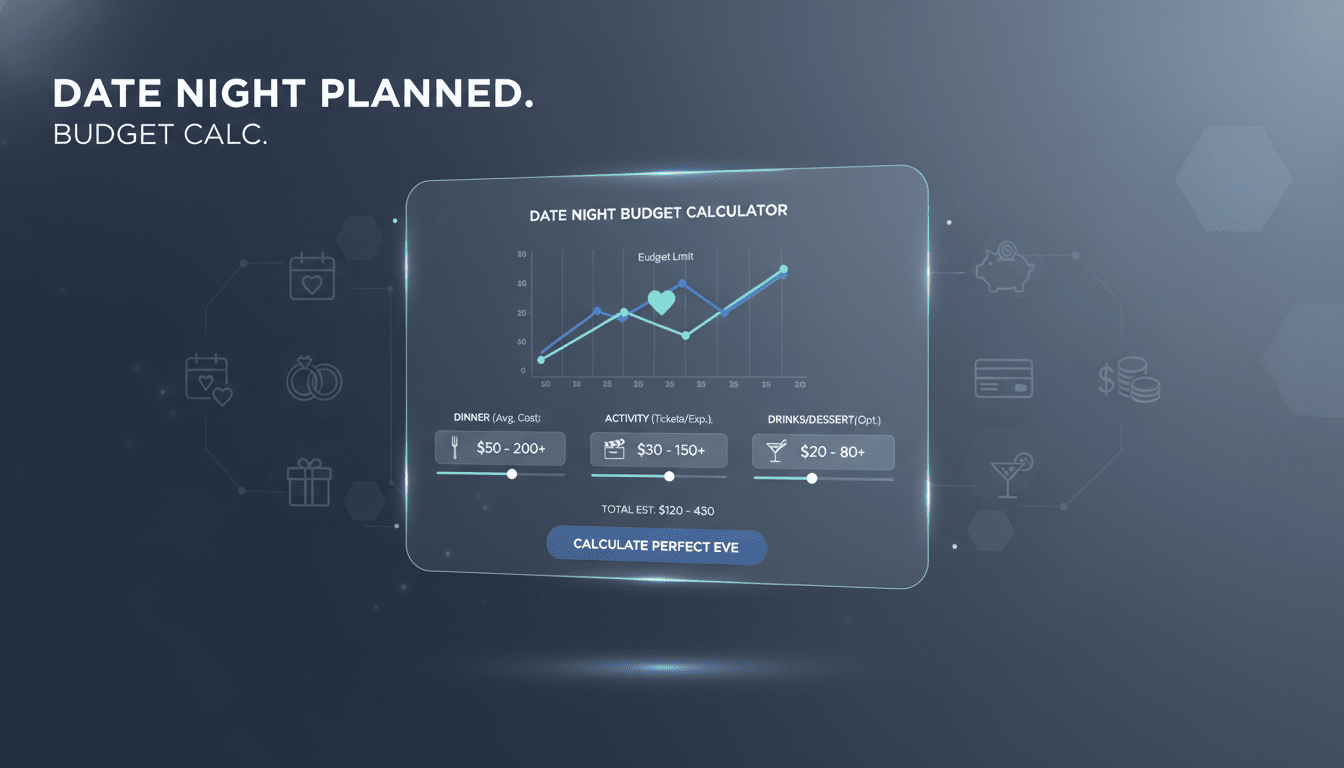
Date Night Budget Estimator
For founders, executives, and high-performance professionals, time is often the scarcest asset in the portfolio. When you finally carve out an evening for a significant other, the objective is to maximize the Return on Experience (ROX). However, financial ambiguity can introduce unnecessary friction into what should be a seamless event. A well-calibrated Date Night Budget Calculator is not about restricting your lifestyle; it is about strategic resource allocation to ensure the evening is memorable for the right reasons.
Whether you are planning a milestone anniversary in a metropolitan hub or a casual evening to decompress, understanding the total cost of ownership (TCO) of the date allows for better decision-making. It prevents the “sticker shock” that can occur when high-margin items like cocktails, valet parking, and childcare services compound. This guide and the interactive tool above are designed to give you a precise forecast of your evening’s financial footprint, allowing you to focus entirely on the connection rather than the bill.
The Economics of the Perfect Evening
In the current economic climate, the cost of leisure has outpaced general inflation in many sectors. For the astute planner, budgeting for a date requires the same rigor as forecasting a quarterly operating budget. You are dealing with variable costs (dining, drinks), fixed costs (tickets, babysitting), and hidden surcharges (taxes, service fees, surge pricing).
By utilizing the calculator above, you move from estimation to precision. This allows you to answer critical questions before the evening begins: Is the premium for the tasting menu justified? Does the cost of a private car service fit within the discretionary spending limit for the month? This level of foresight is the hallmark of a sophisticated approach to personal finance.
Analyzing the Cost Drivers: A Deep Dive
To accurately forecast your evening, we must dissect the components that constitute the final bill. Much like a business P&L statement, a date night budget is composed of several distinct line items, each with its own volatility and inflation rate.
1. The Hospitality Premium (Dining & Drinks)
The core of most date nights involves dining. However, menu prices are rarely the final cost. In major cities, the “prime time” reservation often comes with a premium. Furthermore, the markup on alcohol is the primary profit driver for restaurants, often exceeding 300%.
When calculating this portion of your budget, consider the “tax and tip” multiplier. In many jurisdictions, the combined effect of sales tax and a standard 20-22% gratuity can increase the menu price by nearly a third. If you are dining in a high-tax jurisdiction, such as Boston, utilizing a tax calculator for Massachusetts can help you understand the specific local levies that will apply to your bill. Similarly, if you are traveling abroad for a romantic getaway, understanding the local VAT is crucial. For instance, a dinner in London requires a different calculation than one in New York; checking a tax calculator for London can clarify the VAT implications on your high-end dining experience.
2. The Logistics of Leisure (Transport & Parking)
Transportation is often the most underestimated variable. The choice between driving and rideshare services involves a trade-off between convenience and cost. Valet parking in downtown districts can range from $20 to $60. Conversely, rideshare services utilize dynamic pricing algorithms (surge pricing) that can double the cost of a ride during peak Friday or Saturday evening hours.
If you are planning a date that involves multiple venues—dinner, a show, and a nightcap—the logistical costs compound. A savvy planner might look at the distance and cost ratios. If you are splitting expenses or simply trying to visualize the breakdown of these logistical costs against the total, a fraction calculator can be a useful mental tool to determine what percentage of your total budget is being consumed by merely moving from point A to point B.
3. The “Sitter Tax” (Childcare & Pet Care)
For parents, the cost of a date night is effectively doubled by the requirement for childcare. This is a fixed cost that must be paid regardless of whether you eat at a Michelin-star restaurant or a local taco stand. In many affluent suburbs and cities, the hourly rate for a qualified sitter has risen dramatically.
This expense is non-negotiable and time-dependent. If your evening runs long, this cost scales linearly. It is vital to factor this in as a “sunk cost” of the evening. If you are managing rental properties to supplement your income for these types of expenses, ensuring your cash flow is accurate via a rental income tax calculator is a prudent step in maintaining your lifestyle budget.
Strategic Allocation: Maximizing ROI
Once you have the data from the calculator, the next step is optimization. High-net-worth individuals understand that value is not about the lowest price, but the highest quality per dollar spent. Here are strategies to maximize the ROI of your date night budget.
The High-Low Mix
Fashion executives have long understood the power of the “high-low” mix—pairing a designer piece with basics. This applies to dating as well. You might allocate 70% of your budget to exceptional concert tickets (the “High”) while opting for a casual, authentic pre-show dinner (the “Low”). This creates a memorable peak experience without blowing the budget on a mediocre, overpriced meal near the venue.
Liquidity and Debt Management
It is imperative to fund leisure activities from free cash flow rather than high-interest debt. Putting a luxury evening on a credit card that you cannot pay off immediately is a negative-EV (Expected Value) move. The compounding interest on a $500 date can turn it into a $700 obligation over time. Always run the numbers. If you are relying on credit, use an interest calculator to see the true cost of that evening over six months. If the numbers don’t make sense, scale back the date until liquidity improves.
For those planning a massive, once-in-a-lifetime event—such as an elaborate proposal or a destination engagement—financing might be on the table. In these rare instances, understanding the terms of borrowing is critical. A personal loan calculator can help you structure these larger expenses responsibly, ensuring that your romantic gesture doesn’t become a long-term financial burden.
Geographic Arbitrage in Dating
Your location dictates your purchasing power. A $200 budget in the Midwest provides a luxury experience that might barely cover appetizers and drinks in Manhattan or Zurich. This concept, known as geographic arbitrage, is vital for those who travel for business or pleasure.
If you are a digital nomad or an executive splitting time between offices, be aware of the local cost of living indices. A date in Kansas City offers vastly different economics than one in Oslo. Checking a tax calculator for Kansas versus a tax calculator for Norway reveals not just tax differences, but implies the massive disparity in the cost of services and goods. Adjust your budget inputs accordingly based on the local economy.
Investment in Relationships vs. Assets
Finally, view date nights as an investment in relationship equity. Just as you would not neglect the maintenance of a physical asset, you cannot neglect the maintenance of a partnership. However, this investment must be balanced against other financial goals.
If you are aggressively saving for a home, every dollar spent on leisure competes with your down payment fund. Using a mortgage payoff calculator can help you visualize how discretionary spending impacts your long-term debt-free timeline. It is about finding the equilibrium where you can enjoy the present without sabotaging the future.
Furthermore, for business owners who pay themselves via dividends, understanding your net disposable income is key to setting these budgets. A salary dividend tax calculator ensures that the money you are mentally allocating for leisure is actually yours to spend after the government takes its share.
Frequently Asked Questions
1. How much should I budget for a first date?
For a first date, the goal is to establish a connection without the pressure of an exorbitant price tag. A budget of $50-$100 is usually sufficient for drinks and appetizers or a coffee and activity. This minimizes the financial risk if there is no chemistry while still allowing for a quality experience.
2. Should I include the cost of a new outfit in the budget?
Strictly speaking, clothing is a durable good that retains value beyond the single event. However, if the outfit is purchased specifically for a themed event or gala and is unlikely to be worn again, it should be amortized into the cost of that specific date to get a true TCO.
3. How do I handle bill splitting tactfully?
Communication is key. If you plan to split the bill, discuss it beforehand or simply reach for the check and ask, “Shall we split this?” Modern banking apps make this easy, but if you need to calculate precise ratios based on who ordered what (e.g., one person had alcohol, the other didn’t), a quick calculation is fair. It prevents resentment.
4. Is it worth taking out a loan for a special anniversary trip?
Generally, financing luxury travel is discouraged due to high interest rates. However, if you have a structured repayment plan and the cash flow to support it, it can be done. Always use a loan calculator to understand the total interest paid before committing.
5. How does inflation affect date night budgeting?
Service sector inflation is often higher than the CPI. You should revisit your “standard” date night budget every 6 months. What cost $100 last year may now cost $115 due to rising food and labor costs.
Conclusion
Planning the perfect evening is an art, but funding it is a science. By using the Date Night Budget Calculator, you strip away the anxiety of the unknown and replace it with the confidence of a well-executed plan. Whether you are navigating the high-tax environments of global capitals or maximizing value in your local town, the principles remain the same: assess the variables, account for the hidden costs, and allocate your resources where they generate the most happiness.
Remember, the most expensive date is not always the best date. The best date is one where the focus remains undivided on your partner, facilitated by a financial plan that operates silently and effectively in the background.
